
Welcome to 2026! This will be a great year for me. In just a few months I will begin the long trek that will be The Road To Valour. The route is almost finalized and my training is on schedule. I hope that you will join me for a section of this epic adventure.
In the first few days of the ride I will be visiting my home town, Chilliwack, British Columbia. Chilliwack was also the adopted home of James Cleland Richardson. This is a story I’ve long wanted to tell — one that resonates with me on many levels. Part of it is my love for the soulful sound of the bagpipes and my own Scottish heritage. But more than that, few stories from the Great War blend courage, tradition, and sacrifice as powerfully as that of Piper Richardson, VC.
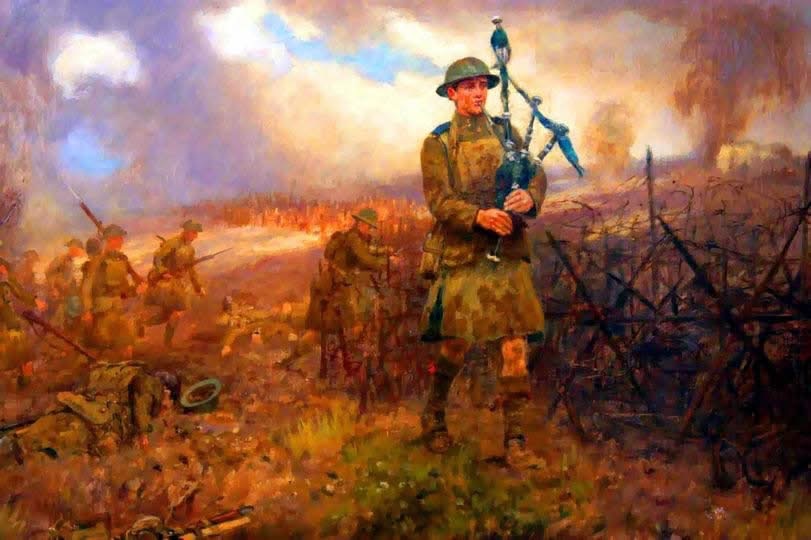
From Bellshill to the Canadian Scottish
James Cleland Richardson was born in Bellshill, Lanarkshire, Scotland in 1895. He immigrated to Canada with his family in 1909, eventually settling in Chilliwack, BC. Chilliwack is my home town. If you read my family history, you will know that I lived there many times. Yet, like so many others there, I was completely unaware of this inspiring Canadian hero.
His story, told in both official records and moving eyewitness accounts, begins in Scotland and ends on the blood-soaked fields of the Somme — yet it resonates eternally in Canada’s memory and song.
Shortly after arriving in Canada he joined the 72nd Battalion, The Seaforth Highlanders of Canada, a militia unit that allowed him to continue his passion for the bagpipes while serving his new country. When war was declared in 1914, he enlisted in the 16th Battalion, The Canadian Scottish Regiment of the Canadian Expeditionary Force (CEF) and sailed for France the following year.
The Battle of the Somme
On October 8, 1916, during the Battle of Ancre Heights, a battle within the larger Battle of the Somme, Richardson’s company faced devastating German fire and uncut barbed wire while attacking Regina Trench. What followed became immortalized in Canadian military history.
Company Sergeant-Major Mackie, who fought beside him, gave this firsthand account:
“When the company came up the enemy started throwing bombs and opened rifle fire… Things looked very bad, and then it was that the piper asked if he would play his pipes — ‘Wull I gie them wund (wind)?’ was what he said. I told him to go ahead, and as soon as he got them going I got what men I could together. We got through the wire and started cleaning up the trench.”
Mackie continued that Richardson walked back and forth before the wire “playing up and down in front of the men for fully ten minutes,” under relentless rifle and machine gun fire. The pipes rallied the soldiers, who surged forward and captured the German position.
The London Gazette Citation
For his “most conspicuous bravery and devotion to duty,” Richardson was posthumously awarded the Victoria Cross, the British Empire’s highest military honour. The official citation, published in the London Gazette on October 22, 1918, reads:
“For most conspicuous bravery and devotion to duty when, prior to attack, he obtained permission from his Commanding Officer to play his company ‘over the top.’ As the Company approached the objective, it was held up by very strong wire and came under intense fire, which caused heavy casualties and demoralised the formation for the moment.
Realising the situation, Piper Richardson strode up and down outside the wire, playing his pipes with the greatest coolness. The effect was instantaneous. Inspired by his splendid example, the Company rushed the wire with such fury and determination that the obstacle was overcome and the position captured.
Later, after participating in bombing operations, he was detailed to take back a wounded comrade and prisoners. After proceeding about 200 yards, Piper Richardson remembered that he had left his pipes behind. Although strongly urged not to do so, he insisted on returning to recover his pipes. He has never been seen since, and death has been presumed accordingly owing to lapse of time.”
The Lost and Found Bagpipes
Richardson’s pipes were lost on the Somme. In 1917, British chaplain Major Edward Yeld Bate found a damaged set of pipes and took them to his school in Crieff, Scotland, where they remained unidentified for decades. In 2002, researchers studying war relics linked the pipes to Richardson using regimental records and tartan patterns. After a joint effort between Scotland and Canada, they were officially repatriated to British Columbia in 2006 in a solemn ceremony at the Legislature in Victoria.
Enduring Legacy
Today, Piper Richardson’s bagpipes are displayed as a national treasure in the British Columbia Legislature. His grave lies in Adanac Military Cemetery, near Courcelette, France, marked by the simple epitaph “He Played Them Over the Top.” His story — of youth, courage, and music amid chaos — reminds the world that even on the harshest battlefield, the sound of human resolve can rise above the roar of war.

Above, Piper Richardson, VC display of this pipes in the British Columbia Legislature.
To the right, the statue of Piper Richardson, VC out side of the City of Chilliwack Museum.
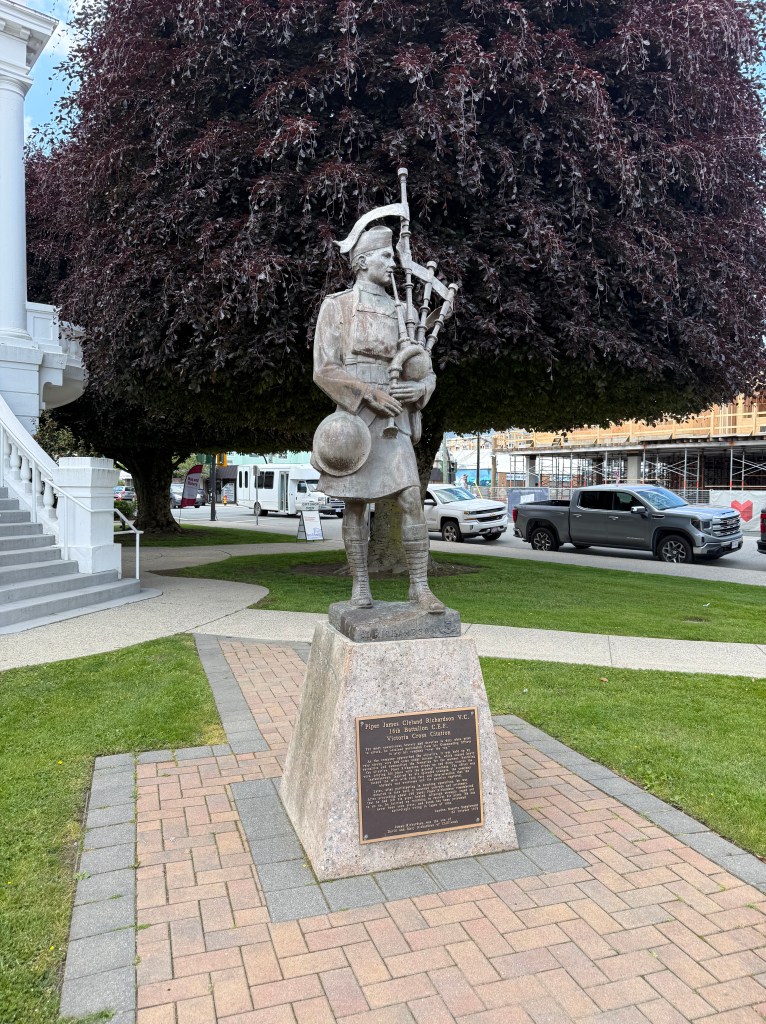
Many memorials to Piper Richardson have been established, in Scotland and in Canada. Of course, his pipes as displayed in the BC Legislature are one. Several videos have been made of his story, including The Sound of The Somme and In Chilliwack, a statue of him was erected beside the Chilliwack Museum (formerly the City Hall). Also, in 1969 the Royal Canadian Legion built a small veterans housing project in Chilliwack and named it for Richardson. Ironically, it was in one of these houses that my grandparents, Ole and Irene Enger, lived in towards the end of their lives.
The Pipes continued to Play
While Piper Richardson’s actions on that day in the Somme were exceptional, his act was not an isolated event. The pipers of the 16th Bn, Canadian Scottish Regiment alone were awarded Richardson’s Victoria Cross, a Distinguished Conduct Medal and nine Military Medals.
Other actions by regimental pipers were also honoured. For example, William Brand and Walter Telfer, pipers from the 25th Bn, The Nova Scotia Rifles, were each awarded the Military Medal for leading their regiment into battle at Vimy Ridge. Most regiments of the Canadian Expeditionary Force maintained pipers and not all of them were highland units.
While the skirl of the pipes could muster a level of courage within the spirit of soldiers, piping was a dangerous action. While Canadian figures cannot be determined, the military forces of the British Empire during WW1 included some 2,500 pipers. Of these, more than 500 were killed and another 600 were seriously wounded.
Play on The Road To Valour
 The Road To Valour