
The Road To Valour ride begins in just five months! While I am looking forward to getting this ride started, I have to admit to a certain degree of trepidation. Many people I have spoken with about the ride – all 2,500 km of riding and 14,000 m of climbing – have asked: Will you have a support vehicle following you? When I say “No. This ride will be unsupported.” they inevitably ask: What if …?
My response to the “What if …?” question is always the same – “Why does there always have to be a ‘What if … What id not …?’” I have prepared for the journey by training myself for long days in the saddle. I am prepared for just about any mechanical issues that may arise. I am ready for the physical issues that will present themselves. I will admit that the one thing that I have not trained myself for (yet) is the long, straight, flat roads of the prairies where the only visible building in the distance never seems to be getting closer. But, I will learn to handle that challenge and not let it be the answer to “What if …?”
On the point of “What if … ?”, have you reviewed your charitable giving budget for 2025 and asked yourself “What if I had a few extra dollars to give and could help our veterans and first responders suffering with a mental disorder resulting from their service to us? ” You can help at donate. Wounded Warriors Canada is a CRA registered charity, along with my thank you for supporting my ride and our veterans and first responders, you will receive a tax receipt to your donation of $Cdn20 or more. That tax receipt can increase your return in 2026, so that you will have more to share in 2026. It’s a wonderful thing – thank you!
For this Christmas post, I wanted to talk (or is that write?) about some of the things that happen at the front lines of war and peace. Christmas can be a difficult time for soldiers in conflict – on both sides of the line.
World War 1
At the outset of World War 1, both sides felt that this would be little more than a skirmish. They thought it would be over by Christmas. After all, no one believed that a modern war could drag on for more than a few months. However, by Christmas, along the Western Front both sides had dug themselves into trenches that stretched from the North Sea to Switzerland.
By Christmas, that dream of an early end to hostilities had vanished. In places, trenches were so close together that troops on both sides could call out to the others. News and greetings were often exchanged. In several quiet sectors, troops on one side would start singing a song. Troops on the other side would then join in in their own language.
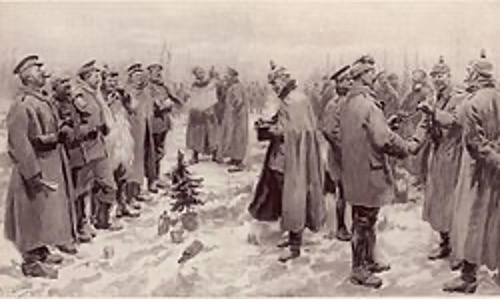
On Christmas Day, 1914, an informal truce settled in over much of the Western Front. In various places, Germans placed candles on their trenches. They also decorated Christmas trees and placed them on the parapets of their trenches. Then, they continued the celebration by singing Christmas carols. The British responded by singing carols of their own. The two sides continued by shouting Christmas greetings to each other. Soon after that, excursions across No Man’s Land began. Small gifts were exchanged, including food, tobacco, and alcohol. Souvenirs, including buttons and hats, were also traded. There are even accounts of soccer matches being played in no-man’s land. Throughout the front, the artillery fell silent.
Throughout the rest of the war, attempts were made by soldiers for other seasonal truces, but none succeeded. High commands on both sides took a firm stand against fraternization with the enemy. To learn more about this amazing moment, I would suggest viewing Truce.
World War 2
While cease fires were not to become part of the Christmas traditions in battle, special events often occurred. The Seaforth Highlanders of Canada’s Christmas dinner in 1943 was a brief but famous wartime feast held in the shattered Italian town of Ortona, only a few hundred metres from fierce street fighting. It has become one of the iconic episodes in Canadian military history because of the contrast between a carefully prepared festive meal and the brutal close‑quarters battle raging outside.
On 20–28 December 1943, the Seaforths were fighting in Ortona as part of the Canadian 1st Infantry Division’s push up the Adriatic coast, a battle so intense it earned the nickname “Little Stalingrad.” Despite continuous house‑to‑house combat and heavy casualties, the unit’s leaders decided their men would still mark Christmas Day with a proper dinner.
The chosen location was the bomb‑damaged church of Santa Maria di Constantinopoli. The church also served as the battalion’s headquarters and offered thick stone walls that gave some protection from the shelling and small‑arms fire only a few blocks away. The battalion quartermaster, Captain D.B. Cameron insisted on providing a “first‑class” Christmas meal in spite of the logistical nightmare. He and his staff scrounged tablecloths, chinaware, candles, and sufficient food and drink to outfit a full sit‑down dinner. Apparently, the menu included soup, roast pork, mixed vegetables such as cauliflower, mashed potatoes with gravy and Christmas pudding. Each man also received beer along with chocolate, fruit and plenty of cigarettes.
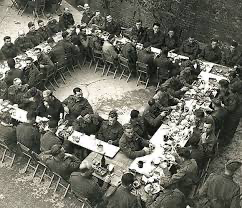
The Seaforths later turned the 1943 Ortona dinner into a regimental tradition. Each December, the regiment holds a commemorative “Ortona Dinner” with a menu closely modelled on the original to honour those who fought and died there.
Korea and Afghanistan
Following the Second World War, Christmas on the front line of a conflict changed markedly. For the first time, Canada and its allies faced adversaries who did not share the Western tradition of observing Christmas.
In Korea, Canadian units like the Royal Canadian Regiment and the Princess Patricia’s Canadian Light Infantry encountered Chinese propaganda efforts, including greeting cards urging surrender, signs like “Come Home Darling,” and a decorated Christmas tree in no-man’s-land that was promptly destroyed by tank fire. Troops dismissed these as ineffective morale-boosters, collecting cards as souvenirs while maintaining patrols. In spite of this, units tried to celebrate and mess tents hosted turkey dinners eaten in shifts.
During the war in Afghanistan, Canadian troops, and those of other allied forces, maintained Christmas traditions by decorating bases, holding religious services and sharing festive meals despite the combat environment. Following a longstanding military tradition, commanding officers would exchange tunics with their most junior soldier and joined other officers to serve turkey dinners with mashed potatoes and stuffing on Christmas Day. In 2006, General Rick Hillier, the Chief of the Defence Staff, visited the troops in Kandahar for Christmas Eve. This was also a time to open gifts from family members, units back home and even kind strangers. These thoughtful presents often included homemade baked goods, festive decorations, and delightful treats.
Afghanistan also the first conflict where Canadian soldiers were able to connect with families at home via Internet cafés. Of course, with the good often comes the not so good. Many accounts describe long lines at Internet cafés as soldiers tried to call home, often mentioning how hard it was to hear family celebrations through a phone while rockets, small‑arms fire, or patrol orders loomed in the background. Several spoke of buddies likely breaking down in tears on December 25 because they missed their children, yet they leaned on each other and on small rituals—coffee together by the tree, a quick photo, a shared joke—before going back into bomb‑strewn villages.
Peacekeeping Operations
On a personal note, I remember being in Nicosia, Cyprus for one Christmas and Ismailia, Egypt on another. Both were tranquil settings without bullets flying.
In Cyprus, it was interesting to see the way the Greek Cypriots would decorate their bunkers with nativity scenes and Christmas trees. The city was quiet and stable. The welfare element of the Canadian contingent organized visits from an entertainment troupe and the normal, albeit very British oriented, Christmas dinner at the UN Headquarters Officers’ Mess.
In Egypt for Christmas 1977, I was a UN Military Observer, tasked with manning the operations office with the UN Emergency Force II along side a Soviet major. We were both invited to the traditional dinner at the Canadian Contingent’s base. However, my Soviet colleague followed the Party line as a devout atheist and was somewhat surprised by the attention to this unusual event. And while he failed to grasp the significance of the day, he relished in the turkey dinner and the accompanying wine (although he commented several times about the lack of vodka).
As you gather with your family to celebrate Christmas and all its warmth and wonder, take a moment to remember those who have faithfully served or are spending the holidays far from home. Their courage and sacrifice remind us of the true spirit of giving and gratitude. Keep them close in your heart this season, and let their dedication inspire you to cherish every moment with those you love.
Ho Ho Ho from The Road To Valour
 The Road To Valour