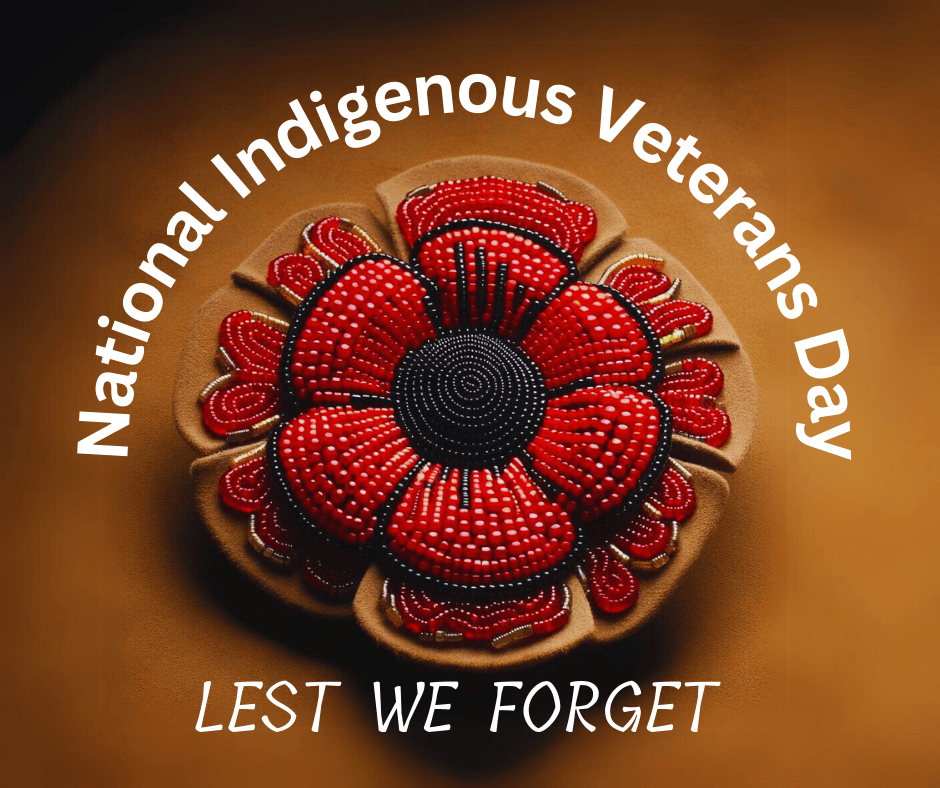
In 2021, the Governor-General declared 8 November to be Indigenous Veterans Day. This was to honour the courage and sacrifice of Canadian Indigenous Veterans — First Nations, Inuit, and Métis men and women who served our country in times of war, conflict, and peace.
Long before they were recognized as citizens, Indigenous peoples volunteered to wear the uniform of a nation that did not yet grant them the rights they so bravely defended. They served with distinction in every major conflict — from the trenches of the First World War to the beaches of Normandy, through the hills of Korea, and in peacekeeping missions around the world.
Their contributions were extraordinary, not only for their military skill and dedication, but for the resilience it took to serve in the face of discrimination at home. Many returned to find that the freedoms they had fought to preserve were still denied to them. Yet, generation after generation, Indigenous Veterans have continued to answer the call — embodying a strength of spirit and a deep sense of duty to protect their land, their communities, and their fellow Canadians.
During the First World War, more than 4,000 Indigenous people served in uniform. It was a remarkable response. In some areas, one in three able-bodied men would volunteer. At least fifty awards for bravery were awarded to Indigenous soldiers of the Canadian Expeditionary Force (CEF). Indigenous recruits joined up for a variety of reasons. Some sought employment or adventure. Others wanted to uphold a warrior tradition. A tradition that saw their ancestors fight alongside the British in earlier military efforts.
However, some estimates of the participation of indigenous fighters have been exaggerated. For example, in some communities, such as the Head of the Lake Band, of the Syilx Okanagan People, in British Columbia, have been reported to have had every able man between 20 and 35 years of age enlisted. According to one Syilx historian, this is not the case. While the entire male population did not enrol, many did and they contributed
Private George McLean, a proud member of the Head of the Lake Band embodied the courage and dedication of Indigenous service members. A veteran of both the Boer War, McLean re-enlisted in 1916 and fought with remarkable bravery at Vimy Ridge. During that battle, he single-handedly captured 19 enemy soldiers before being wounded in action, an act of heroism that earned him the Distinguished Conduct Medal, one of the highest awards for gallantry. After the war, McLean returned home and continued his life of service as a firefighter, leaving behind a legacy of courage, humility, and steadfast devotion to both his people and his country.
During the Second World War, the warrior traditions took hold again. More than 3,000 members of the First Nations, including 72 women, volunteered for the war effort, serving in both Canadian and American forces. As well, an unidentified number of Métis, Inuit and other indigenous people signed up. During the war at least 17 awards for valour in combat were earned. One member of the Syilx People, David Parker, was a member of the original Special Service Force (better known as the Devil’s Brigade), serving in many of their renowned battles, like Monte Cassino and operation Market Garden.

Many Indigenous soldiers called upon traditional hunting, scouting and disciplinary skills to deadly effect as snipers, scouts and messengers. The duties were straightforward and dangerous. Snipers kept the enemy unnerved with their rifle-fire by shooting at targets from concealed positions. Scouts and messengers moved behind enemy lines in advance of an attack to find out the enemy’s positions and capabilities. The stories below represent just a few.

Francis Pegahmagabow, better known as “Peggy”, was the most decorated Indigenous soldier of the First World War. An Ojibwa from the Perry Island Band in Ontario, he enlisted almost immediately following the declaration of war. He was awarded the Military Medal (MM) plus two bars for acts of bravery in Belgium and France. His original MM was awarded in recognition of “continuous service as a messenger from February 1915 to February 1916.” His first bar to the Military Medal was won during the Battle of Passchendaele. His second bar was won during the final months of the War in the Battle of the Scarpe.
Pegahmagabow was one of only 39 members of the CEF who received two bars to the Military Medal. You can read more about this brave soldier at A Peaceful Man
Two sons of the Six Nations Cayuga chief, Alexander George Smith, Alexander Jr. and Charles Smith, enlisted three months after the outbreak of the war. Both served overseas as officers, achieving the rank of Captain, and both were awarded the Military Cross (MC) for gallantry. Alex, Jr. earned his MC during the second Allied assault on the Somme. He was wounded and recovered to return to his unit. Eventually he became sick. He was returned to Canada. There, he was posted to a camp where many Polish soldiers trained. When the war ended, he was one of only 5 Canadians to be named an Officer of the Order of the Black Star. This is a Polish order in recognition of his distinguished service at the camp. His younger brother, Charles, earned his MC on the road to Mons, just two days before the end of the war.
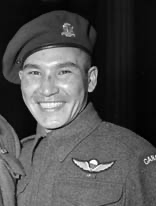
Sergeant Thomas “Tommy” Prince, MM, of the Brokenhead Ojibway Nation in Manitoba, was one of Canada’s most decorated Indigenous soldiers. A descendant of Chief Peguis, he served with distinction in both the Second World War and the Korean War, earning 11 medals, including the Military Medal and the U.S. Silver Star. He also was a member of the elite Special Service Force, carrying out daring reconnaissance missions behind enemy lines. Despite facing discrimination after returning home, Prince remained a fierce advocate for Indigenous Veterans, leaving behind a lasting legacy of courage, leadership, and unwavering service to Canada.
Sam Glode was a Mi’kmaq from Nova Scotia. He joined the CEF at the age of 35 as a sapper with Company 6, Royal Canadian Engineers. The company dug tunnels, carved dugouts in Vimy and patched roads near Amiens. Shortly after the Armistice, the Canadian Corps was moving towards Germany for occupation duties. Glode was with a team searching for mines and demolition charges. On 19 and 20 November, 1918, he was awarded the Distinguished Conduct Medal (DCM). The citation read “He showed great devotion to duty and an utter disregard of personal danger.”

More than 4,000 Indigenous soldiers served with the CEF. However, the actual number is much larger. Records are not precise, and many of the “non-status Indians” and Metis were not included. In all, more than 300 “status Indians” died during the War. Hundreds more were wounded, in body and in mind. The actual toll to the First Nations of Canada will never be fully understood.
Three Day Road
A couple of years ago, I read Joseph Boyden’s award winning novel: Three Day Road. The name is taken from a story about how those ready for death must walk the “three day road.” The novel itself was inspired by the adventures of Francis Pegamagabow.
This is the story of two young Cree men who join the CEF and are deployed to Europe. Only one survives. It follows his journey to recover. This is among the most powerful books I have read about World War 1. In my mind, it is comparable to the classic All’s Quiet on the Western Front.
Their first contact with the enemy was in the St. Elois craters. The descriptions of the fighting and the fear of snipers was powerful. Reading this was particularly poignant for me. My grandfather was awarded the Military Medal for his actions in these craters. Read his story.

Throughout the novel, Boyden highlights the impact of colonization on the indigenous peoples. He reveals their struggles to be accepted in society. He also depicts the difficulties they experienced upon their return.
As The Road To Valour continues to shine a light on the stories of courage and service that have shaped Canada, we are proud to stand in recognition of Indigenous Veterans — their heritage, their strength, and their enduring legacy.
To all Indigenous Veterans and their families: thank you. Your service and sacrifice continue to guide our nation toward understanding, reconciliation, and respect.
 The Road To Valour