
I first became aware of and involved with Wounded Warriors Canada (WWC) in 2018. Bob Harding, a triathlon friend of mine here in Lake Country, and I had decided that we would make the pilgrimage to Juno Beach for the 75th anniversary of Operation Overlord. Better known as D-Day, the anniversary was 6 June 2019. Bob’s uncle, Sergeant D. Mills, Royal Canadian Artillery, had been killed in action shortly after the landings. Bob wanted to visit his uncle’s grave. For me, it was about the history.
The picture above is of La Maison de Canadiens or Canada House. It was the first house to be liberated during Operation Overlord. This will be the topic of a future post.
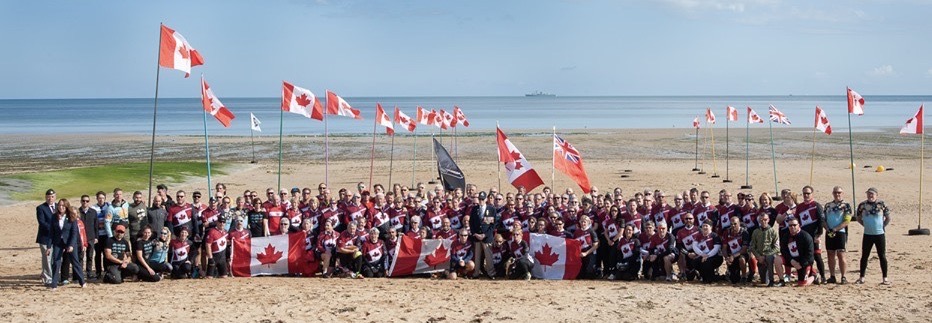
From a web search of cycle groups planning tours for the event we found the Battlefield Bike Ride (BBR). It was a fundraiser for WWC. This seemed a perfect fit. Military history, cycling in Europe and fundraising for a very important charitable group; how could we go wrong? We signed up!
We learned that WWC was a national mental health service provider. It is dedicated to serving Military, Veterans and First Responders who develop mental disorders as a result of their service. It also serves their families. That definition has since been refined. It now includes a much broader array of uniformed professionals. These professionals’ job is to serve and protect our society and the people within it.
I found out later that my connection to WWC ran much deeper. In 1978, after finishing my tour as a UN Military Observer with the UN Truce Supervision Organization in the Middle East, I was posted to 2 Field Engineer Regiment (now 32 Combat Engineer Regiment) in Toronto as the regular force Unit Support Officer. During the Afghan War, a young sapper from this unit was on a patrol. An IED exploded and badly injured him. He was rushed to a US military hospital in Germany. His prognosis was not good, but he survived. As a sapper myself and as a former support officer for this unit, I felt the connection run deep. His injury led to the creation of a small charitable support group. This group arose to help him and other Canadian soldiers injured in that war. It has since developed into the WWC that I am now, with your help, supporting.
Following my first BBR in 2019, I have completed 2 others. With the help of my supporters, I have raised about $50,000 for the work that they do. So, what is that work? Let’s start with who is supported and who better to answer that question than Dr. Tim Black, R.Psych., WWC’s National Clinical Director?
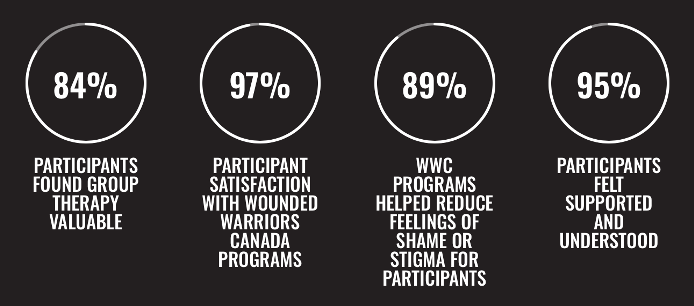
I think it is also important to understand the impact that WWC has on our TExPs. So, some numbers:

CAPTURING PARTICIPANT SATISFACTION
All participants of WWC’s programs are surveyed upon program completion and are analyzed by the Nanos Research Group. The results provide valuable insight into participant satisfaction and ways for maintaining and improving delivery of our group therapy programs.
In future posts I will discuss some of the programs that most relate to my own situation. I will also explain why this journey down The Road To Valour is so personal. But, if you are interested in digging into that involvement and support, please visit their website. You can find it at woundedwarriors.ca.
Welcome to The Road To Valour!
 The Road To Valour